wordsout
Welcome
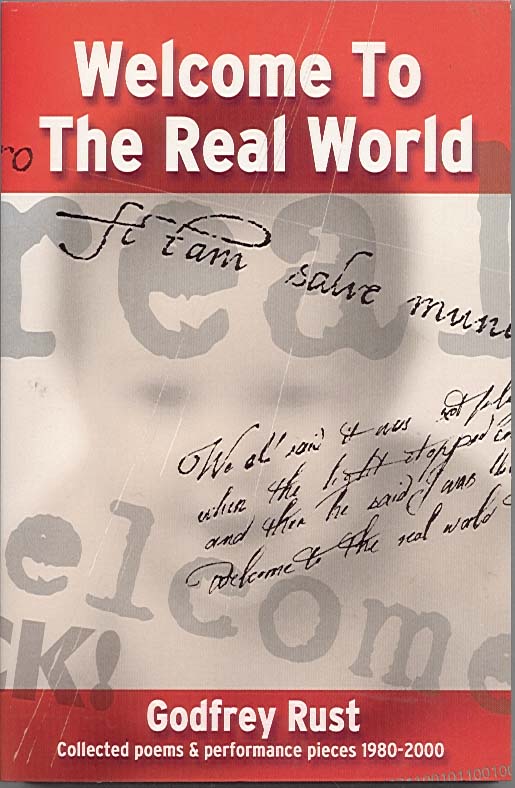
To The Real World about
introduction
Introduction
to Welcome To The
Real World
A poem is a door
between two worlds.
A good poem
opens from the everyday world of
circumstance in which it is being read or listened to, into a world of
imagination
in which surprising things happen and in which improbable things exist
side by
side.
If you are
lucky, as you stand in the doorway that
the poem has opened, you will find that this glimpse of these other
worlds
changes—sometimes forever—your understanding of the everyday world with
which
you thought you were familiar.
Which of these
worlds is the most real?
This book
contains pieces written over a period of
twenty years. My first, home-produced, collection The
Place Where Socks Go appeared in 1985 in
response to demand for copies of poems performed at concerts with Geoff
Shattock. This grew into Breaking
the Chains (1992) which included The
sailing of the ark, and
is reprinted here unchanged apart from minor corrections and some
updated
references. The remaining poems, written since 1992, are published here
under
the title Welcome to the real world in book form for the first time.
These poems are
doors with locks on them. You bring
to the poem the keys of your experience, and because your history and
mine are
not the same, not all these doors will open, or open completely, for
you.
Anyone over
forty and living in the
This is not a
book of religious or devotional verse,
but its perspective is clearly Christian. There will be those who look
here for
an underlying theology, to place it, for example, in an evangelical, or
liberal, or mystical tradition.
There is
a binding logic to be found here:
that the life, death and resurrection of Jesus were both historical and
spiritual events, and are the defining expressions of God’s
relationship with
humanity.
But a very big
change is going on around us. At the
beginning of the 21st century we find ourselves firmly rooted in
postmodernity,
the first radically new phase of western culture for over half a
millennium
(though to be firmly rooted in anything postmodern is, of course,
something of
a contradiction in terms).
Propositions
have given way to stories, positions to
views. We have become defined by what we consume, not what we produce.
Opinion
has supplanted truth, in our debating as much as our advertising. The
exercise
of choice has become our principal form of worship, and we are tolerant
of
anything except dogma. Our identities dissolve into a series of
disconnected
images—we are what we seem.
This is a
dramatic shift in our culture. The ground
was prepared by scientists: Einstein (with Relativity) and Heisenberg
(with
quantum mechanics) discovered early in the 20th century that the
workings of
our universe are weird—and its scale huge—beyond all imagination. Both
time and
space are relative and unpredictable. More disturbing than that, at the
extreme
limits of speed and mass, time and space become impossible to tell
apart. In
the everyday world, nothing is really the way it seems.
The comforting
certainty of
—this abomination
that brings
desolation, this god of matter
to whose altar we have
been dragged
(The
sailing of the ark, sonnet 11)
Now, driven by
global commercial competition and the
24-hour casino of the stock market, we are rushing headlong into the
next
phase, that of the Internet, in which the 'real' is replaced by the
virtual.
The pace of technological development in computing and medicine over
the next
century will be staggering: its consequences are unimaginable.
Everything,
including life itself, is up for grabs.
All of this
deals body blows to conventional thought
and behaviour. Formal Christianity is in the firing line as much, if
not more,
than anything else. 21st century postmodernity smiles blankly and
ironically at
evangelical phariseeism and declines to be interested in its tedious
drawing of
borderlines.
Of course this
is threatening. God as an objective
person is deeply unfashionable: in postmodern thought, everything is a
view.
Already dismissed by philosophy as irrational and science as
unknowable, God is
now redefined by popular culture as a consumer option.
But
postmodernity is also liberating for
Christianity. It is no coincidence that Jesus chose the parable, and
the
postmodern emphasis on stories rather than creeds brings us closer to
the 1st
century than, say, the mid 20th.
One of the most
empowering features of postmodernity
is that it is no respecter of person or tradition. It is not afraid to
say when
the emperor has no clothes (or is at least clad in extremely threadbare
underwear). Christians have been doing the same and, having found they
have not
been struck down with a thunderbolt for voicing their doubts and
concerns, have
been encouraged to think that there may be other ways to embrace
radical
discipleship other than those formulated in the middle of the twentieth
century
around western prosperity and the Four Spiritual Laws.
The
sailing of the ark documents my own
journey into postmodern
Christianity. As I wrote in the original introduction to this poem, I
had found
modern evangelicalism a creed spelled out in black and white, and the
God of
the manger and the wilderness was not to be pinned down so easily.
Postmodernism
does not say there is no objective
truth: it only says that, if there is, we can never know it. Postmodern
Christianity agrees that we can only know truth “as in a mirror,
darkly”.
Faith, hope and love are the means of access to the real world. Parable
and
metaphor—that is, poetry—provide some glimpses of it.
In this book,
ideas in different poems sometimes
appear at odds with one another; but life is not tidy, and for
precedents I
point to Job, the Psalms and Ecclesiastes; more recently to Gerard
Manley
Hopkins' “terrible sonnets” and to James K Baxter, whose fractured
sonnet form I
borrowed for the
The style of
these pieces varies according to their
origin and purpose. Many were written with performance in mind (after
more than
a decade of commissions for Christmas Carol services I think I have
covered the
Nativity from every angle with the possible exception of the donkey).
For those
who wish to read or perform some of these pieces in worship services or
other
events I have provided some notes and an index of themes at the end of
the
book.
Throughout 1999
I was determined not to write a
Millennium poem. Song
at the start of a century is it.
For ideas,
encouragement, criticism and
(unpaid!) commissions I am especially grateful to Mark
Bratton, Isobel
Montgomery, Stan and Judith Dakin, Gill Dallow, Colin and Mary
Duckworth, James and Mary Lazarus, Donald McRobbie, John and Carina
Persson,
Jackie Runcorn, Geoff Shattock, Joanna Whitfield and most of all my
wife Tessa,
children Emma, Joel and Adam, and mother Joan.
For help and
advice in the production and marketing
of this book I am also indebted to Julianna Franchetti, Chris Gander,
Colin and
Steve Taylor and Julie Woods.
All three
sections of this book come to their
conclusive points at the cross. Christ’s instruction that “he who would
find
his life must lose it” goes beyond both reason and common sense: love
is literally absurd.
But I have found
these conclusions inescapable:
first, that God’s behaviour is subversive. Secondly, that all important
truth
is paradoxical. And lastly, that love in the form of self-sacrificial
forgiveness is the most powerful force in the universe. These are
co-ordinates
of the real world.
Godfrey Rust, 2000
.